

Early in my career I worked at Kraft General Foods, R&D where I shared an office with two other colleagues. We had one PC terminal. It was pre-internet, early email days. Emails came once, maybe twice a week and only a handful of them. The rest came by what I’ll call the stagecoach; the internal post. I had to get my own information from a handful of sources; library written papers. I talked to people, picked up the phone or walked to other offices. I got work done, and I never found it to be inefficient.
I collected research, I experimented and generated my own data and I made decisions. I’ll bet money on the fact that the conclusions I made based on a handful of sources would not be that significantly different if I had 100 times the volume of input.
Years later, as a general manager, I still believe that 80% of information on time is better than 100% late. The pursuit of absolute answers and the endless optimization and analysis we do doesn’t necessarily help make better decisions. It does however ensure we avoid judgment and avoid responsibility. This won’t change with AI unless something else does.
We’ve built this problem
Somewhere between that research and development lab and today we built something unbelievable and we called it a productivity improvement. That’s what it was at the start. The inbox, the workflow to the report that feeds another report; a content calendar, the meeting to prepare for a meeting. All are digital dust. The debris of three decades of knowledge work layered so finely, that most people aren’t able to see it. They are inside it.
Take a step back and look. Knowledge workers create much of their own inefficiency, then hire people to manage it and then buy software to manage those people. And we wonder why it never feels enough?
Technology didn’t just land on us. We built it. We built the always on email culture, the notification economy, the proliferation of communication channels that seem to somehow produce less real communication in the long run (that’s an entirely new post waiting to be penned). We didn’t start by being buried under a digital process that needed controlling, we actually created it one step at a time and let the guardrails on the rest slip.
This is where I find it quite comical. We’re deploying the most powerful technology in human history, but we’re using it first to manage the messed up technology we created. Is this not a drama of resource wastage? Should we really do this?
The view from outside
In the last few months, having stepped away from large corporate organizations after 30 years of being inside, the bureaucracy that was wrapped around my daily life has gone. I suppose I had stopped noticing things, but that bureaucracy hasn’t followed me home, and it doesn’t currently exist in my combination of work; a portfolio life as an advisor, a leader, speaker, and an author. Let’s hope it stays like that.
It is also possible that I am adopting and learning AI differently by being on the outside of the complex systems. I’m using it to extend my knowledge in
a way I choose, to challenge my thinking, not really to automate, because I don’t have endless personal workflows to remove.
But as I look at most organizations, they seem to be using AI to automate the dust that we created. Whether that is summarizing emails or scheduling more content or streaming approvals, creating personalized reports. It’s a huge investment, but we’re using it on top of processes that exist only because other processes are still there and broken. Is this not madness?
The question comes before the tool
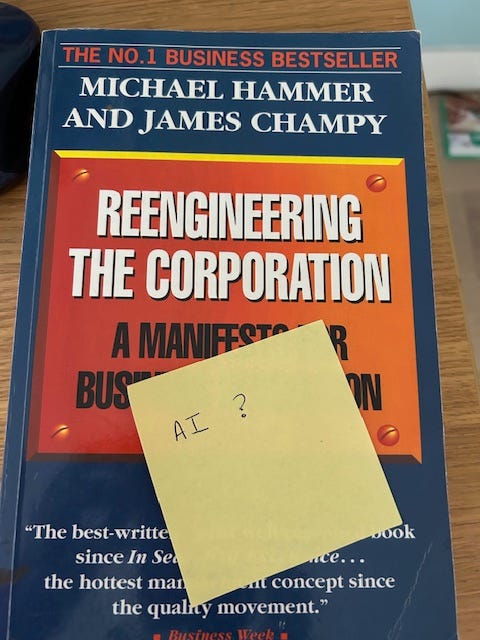
As I glance at my modest line of books near my desk one makes me smile. Michael Hammer and James Champy. These two were right on the money when they wrote Re-engineering the Corporation in 1993, making an argument so obvious it seemed immediately overlooked.
Don’t automate a bad process. If you automate a bad process you get a faster, bad process.
It’s harder to make something simple, (that goes for writing too) but that’s the discipline. Ask first should a process or the step even exist, let alone should we speed it up.
That was a cool message back then in 1993 and it’s one most organizations should start asking again now.
It takes a lot to slow down in order to question, but shouldn’t we be asking; “How do we go from A to B to C, and to be faster do we even need to go to D at all? What happens if we were to go straight to E?”
That might be a harder question than it sounds because it threatens people who own processes, who own road maps and who might want to sandbag their existence. It requires us to look at something which we built and genuinely ask should it have been built at all, and is now the time that we should remove it?
AI should not be the answer to the mess we made, but it is an excuse to finally clean it up. That requires that we laugh at what we put in place and that maybe we got it wrong. But we can use AI or technology to serve something better and not just prop up something that maybe should go away.
Stop, remove then automate
The office at Kraft didn’t feel like a constraint, it was simple, but the clarity it brought was valuable; clear of thinking, faster decisions, and genuine accountability for what you did.
That type of work doesn’t have to be gone. It’s just currently buried.
The next automation question needs to be. Does this need to be faster or does it simply need to stop?
As I look at how I can use AI in my private life - to ensure I am learning with all use cases in mind, I don’t see much. Perhaps my personal email inbox? Then again I can just open it, select 95% of the messages and hit delete. It takes a few minutes, no automation needed.
If there’s something that doesn’t need to be automated, there’s a reasonable chance it doesn’t need to be in existence at.
Take it away. Laugh at the fallacy. Then and only then will we have space to decide what a technology is actually for.
Have a great week
It occurs to me we spend a lot of time with the data and the tech with the express purpose of validating our original instinct.