

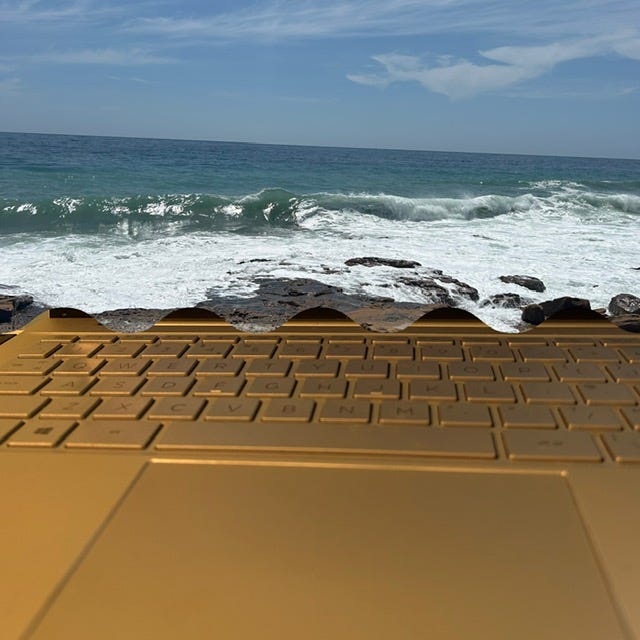
A couple of days before my last holiday a friend who was going with me, asked me
“Are you taking your laptop?”
I didn’t have to think long. I answered immediately. “No, I’m going on holiday.”
As I said that I realised that a holiday is no longer what it used to be. I grew up, looking at getting away as being both literal, in terms of a new destination and mentally, in leaving the daily grind, the household chores, the admin, the work behind.
But as our world of remote work has morphed, I’m left wondering whether the holiday really is about the destination or about the ability to simply switch off and out?
Learning to leave behind
Over the last decade I got better at leaving my work behind, not taking emails on holiday or at the weekend for that matter. I saw plenty of people around the pool glued to their phones or answering mails to me (when I was in the office) when I knew there were quite clearly between two G&T’s.
It is of course everybody’s choice how they spend their time off. I remember years earlier standing on a chair in the corner of a cottage garden on a remote cliff top trying to get a signal because somebody needed me at work. I now wonder how important was that really? And whether people decided to track me and involve me as there wasn’t a strong bench behind me to be able to pick up the slack when I was gone? I sought to change that.
Over the years, I learned to let go fully, but it took many mind shifts to do it
View taking a holiday as a leadership skill
Holidays may look like they are simply self care, but there’s more to it.
Firstly it shows trust. If I find myself to be indispensable, I haven’t set the trust with a team to step in on my behalf. Further, still, I deny somebody that development opportunity to step in for me whenever I’m away. It’s the perfect breeding ground for a successor or stretch challenge for those wondering what it’s like in my role.
The fact that my team relies on me to be there, makes it less a team. It’s not a team. It’s at the mercy of one person and one pin in a system. Being too important is a breakage waiting to happen.
Secondly, it sets the standard. If I can’t take a holiday, what do I role model? Am I saying that holidays don’t matter at my level, they are for junior people, or that no-one should drop work? This is of course nonsense. We all need a holiday. They are there for a reason, failing to take one in my view sets a bad example they pressurise these others to not take one either.
Thirdly and importantly it is good long-term hygiene. I know that taking a holiday from things, be that my kids, my admin or my job or, simply putting the bins out, switching out is an important part of endurance. Life is relentless and no-one runs an eternal marathon. Resilience is needed for our physical and our mental health. The holiday builds us up. And so not taking a holiday is a weakness not a strength.
What if holidays improved your decisions?
I’ve seen over the years that better decisions are made when people are rested, relaxed or recharged. Worse ones are made when people are tired, pressured, and the clarity of thought is compromised. The latter happens when we go too long without a break. Even machines get downtime scheduled; so we should think about that too? (That’s a whole new post coming shortly).
So if all these things are so important, why are we failing to prioritise holidays for what they are?
We have simply forgotten to practice
I think we have forgotten how to take a holiday. We haven’t forgotten how to travel to pick destinations to go to the spa or the mountains to do things, but when we take our laptop with us, we take the mental burden. We take our work. We don’t leave.
It takes a strong self-assured person to decline that temptation, to protect the hard earned mental and physical downtime that we need. Time with family or time alone or time with friends; time with activity, time with stillness. What matters is not what you do, but it matters that you mentally leave things behind not just the physical location you started from.
Taking holiday is about the practice of switching off from more than just the micro things of a normal week. It is a discipline of deciding to recharge.
Perhaps in our connected societies and remote working possibilities we’re not really going on holiday. We are just changing our desk view for better scenery.
As I headed off without the laptop stuck in my bag, I realised I was actually heading to the same location I went recently for a deeply productive writing week. I had been working there intensely, but now I the destination would be my holiday. This was hard evidence that the holiday is not the actual place, but the fact that we choose to leave mentally. It is about how you leave things behind.
So the snapshot to leave you with it this:
When you fail to take a holiday, you’re damaging your team and yourself.
The leadership skill is to see taking holidays as both a discipline and a duty. We need to leave things behind and reload not just for our own benefits, but for those of our teams and our organization.
Ask yourself when did you actually take a real holiday?
Have a great week.