

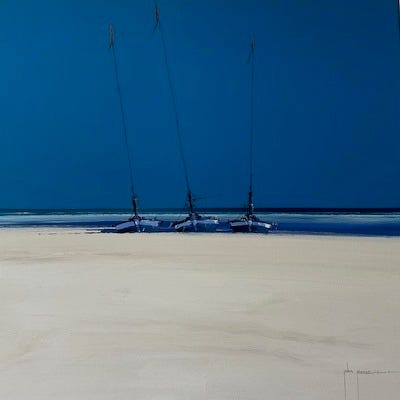
25 years ago I went with a friend to help choose some art for their home. I left with a painting I hadn’t planned to buy, in a country where I wasn’t living and with no clear logistics to get it home.
Three boats on a pristine beach. Deep blue sky. White sand. It was captivating. As I stood in front of it, I could feel the beating heat of the midday sun. There was no actual sun in the picture, no yellow. But I could feel it nonetheless. I described what I felt so that my friend could see how he could know when a piece of art was right. I didn’t know any other rationale. I realised then that I had been inside the painting for at least 20 minutes.
Great art does that. Put you in the picture that transports you away from your surroundings and utterly focuses you, and your mind. You feel it you are part of it. I’m not a painter so I don’t know if that’s what they aim for, but I do know when I speak I want my audience to be captivated.
It moved me so much that I purchased it. It was my first original canvas. It wasn’t a practical purchase. In fact it was months before I found an affordable way to easily transport it overseas to join me. But I wasn’t prepared to walk away from it. The cost of losing felt higher than the cost of committing. I guess that’s what judgement looks like. Not the absence of doubt, but the clarity and the confidence of a risk that’s worth taking, and the willingness to act.
I’ve never regretted that painting and it has adorned every fireplace in the places I’ve lived in during those 25 years. It still makes me smile.
Translation
Most leaders aim to be understood. Best in class may aim to be felt. If we think in logic and use data to help decide, then want to try and land an outcome in someone’s mind, there is a translation step needed. So many people skip the translation step, but when you skip it your message doesn’t get remembered. For those who don’t skip it, their messages, their strategies live and get carried. They exist in the minds of the people they were made for, such that they are able to take action because they can feel it. Between thinking and speaking their is a choice. What do you want people to see?
Frame it
Why not start with a picture? An actual one or a mental image, just give people something to aspire to. Don’t start with your words, even though you’re going to communicate much with them. The best communicators start with the image they want to leave behind and they build backwards. Words become effectively the artist brushstrokes as they paint that image in your mind.
I plan for communications and presentations by asking myself:
What do I want my audience to think?
What do I want them to feel?
What do I want them to do?
I learned that precise framing from a wonderful communication coach, though I realised I was doing it through pictures without being aware.
I storyboard and I start with the final slide, what I want you to leave with and work backwards. What arguments, data or images would I need to put together so people believe and leave with that idea. I do the same whether it’s a new plan, a strategy, a major decision.
Many people start with words and hope that the picture will form. I’m not sure that it does.
Pictures make it easier
I continually create metaphors, not because they’re catchy or as a decoration to my speeches, but because they help translate my ideas. They take something unfamiliar, something difficult, something complex and compare it to something familiar. That familiarity evokes a feeling. That is association is often enough. Enough to build your picture.
The formula starts with a question, for every pitch, every development conversation if it matters.
What is the picture I’m trying to paint?
Don’t ask, what information do I want to deliver? Ask how do you want somebody to feel when they relive or recall your topic months from now? Which image will make you and the topic memorable?
That is the formula it’s not just the clarity of the completeness it’s the way that you capture the topic and their imagination.
Three boats, deep blue sky, perfect white sand. No sun in the painting. I can still feel the heat.
The portability of ideas, plans or decisions matters. Thinking whether a picture will travel without you in the room, depends on the picture you paint.
Let me ask you. What is the picture you are building next in your work, and will it travel once you have left the room?
Have a great week.