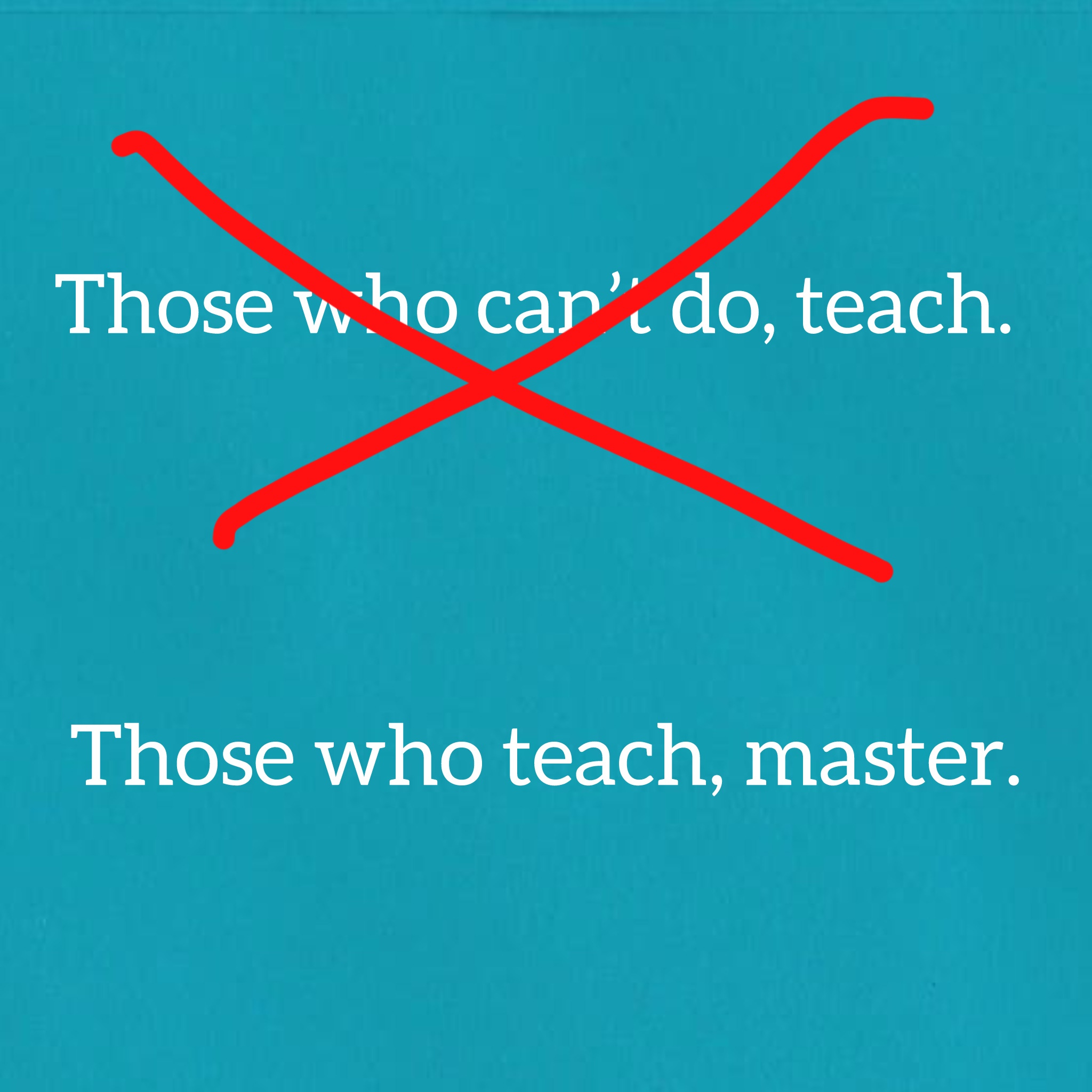
Many years ago I heard the phrase “Those who can, do, and those who can’t, teach.”
It was a phrase that stung. Perhaps one that even prompted shame. Both my parents were teachers, grandparents were teachers. Many people I know are teachers too. I was already in the business world when I heard it, so it wasn’t that it made me avoid a career choice. I did perhaps double down on doing, not steering towards teaching. I saw the practicality of doing, rather than advising, as the stronger route. Wrongly so.
What I should have asked sooner
As I reflect now, it would’ve been better to instantly challenge the phrase, or seek to understand it. But young and impressionable as I was, I took it on face value.
Years later, I decided to see where it came from, having held teaching in such a poor light. It was contrary to everything I was seeing, and the art of teaching itself, so I looked again.
Origins of the phrase are traced to the Irish playwright George Bernard Shaw, who used it as a dig at revolutionaries or reformers. The idea that those who can no longer bring about change, decide to teach others how to do it. Retreating into words instead of actions.
This was never aimed at the teaching profession, but it did indeed contribute to negative views of the teaching profession, suggesting teachers are those who have failed in their profession.
His words, “He who can does, he who cannot, teaches.” have themselves been attributed to many people, as the phrase itself became distorted. The origin itself being as disputed as the meaning it seems.
Many other public figures have added to it, including Woody Allen I believe, “Those who can’t do, teach; and those who can’t teach, teach gym.”
There is no sense in these lines. There is often no sense in phrases we pass around, and yet we frequently fail to challenge them.
What else are we not questioning?
In the world of work, we throw phrases, buzzwords, catch phrases around too often and we assume understanding. We take the absence of questions or nodding of heads to mean understanding. We never check in enough to see if the way people interpret what we say is actually what we meant.
How many other phrases, like the one I misread, occupy the minds of bright people shaping their future, and inadvertently affect the actions they take or those actions that they seek to avoid?
For leaders, ensuring that what you want to communicate not only lands well, but is understood in the way you had intended it to be perceived, is a skill. It’s one I seek to improve regularly as it is core to so many things in work, in society, in cultures.
Do we set environments where people are comfortable challenging when their interpretation is sketchy or if we leave them unclear? I hope so. But hope is not a plan, we need intentionality to make a change. We need to check in and be ready to repeat, re-phrase and reload when we communicate words.
Teaching is actually mastery
There is more when we look closer at teaching. Teaching itself accelerates the teacher’s understanding.
As I mature in my own career, I invest more time in developing others, mentoring or coaching too, and helping people learn. I regularly take the stage to share thoughts and distil ideas for others, be that leadership or the industries and challenges that have made my own career so varied.
Having accountability, or the responsibility to nurture people, that’s not necessarily a harder thing. It is different.
I am perhaps evolved enough now to become a teacher, a voice that can help. The irony here is that I wouldn’t be capable of doing this if I hadn’t already done some of this. So being able to teach, is in my view, not only a luxury, it seems to be something you reach as you progress. It feels like a compliment, a reward, and indeed a responsibility.
But learning itself, is never finished, and I believe the idea that if you want to really master something, you should try teaching it. The very act of trying to explain it in more simple terms, to those not yet of the same understanding, forces you to revisit what you really know about something and distil it. Cutting it down to its bare bones.
I remind myself that if I can’t explain something to a four-year-old I don’t understand it fully myself.
I am a leader, speaker and author, and very much still learning in all of them. In trying to teach some of them, I learn continuously, I stay open for feedback and I improve
.
This past week in India I spent time with some seriously inspiring entrepreneurs. Some of whom are building teaching institutions, some involved in teaching too. Caring for the minds of many generations. Thinking and designing what people need to learn, and delivering the messages to create the societies we need in the future. It is really important work. I also had a glimpse of the skills it takes to get that all off the ground. To continue to shape positively, the most difficult of audiences, young impressionable minds, is one of the hardest tasks there is.
I was in India for some speaking engagements. I was tackling topics around data and automation and human judgment, and although I had done what I thought was a good job in distilling the big ideas, a very helpful question from the audience helped me take the chance to simplify it even further. Removing words I had taken for granted as being widely understood, which perhaps could have sent someone in the wrong direction. Easy to do, and easy to call out if we are brave enough.
I received a lesson, whilst I was teaching one.
I wrap up the week with new admiration for the teaching profession. I am inspired too, to do better myself, to impart learnings where I can, to help the minds that I touch as a leader, a speaker, and an author and of course as human being.
I want to get better at all of it, so I seek to be worthy enough to teach.
I am starting to look at mechanisms that would prompt me to question more frequently.
How would you know if you are on the receiving end of a phrase that needs another look?
Have a great week.
Fiona
Look again. See what was always there.