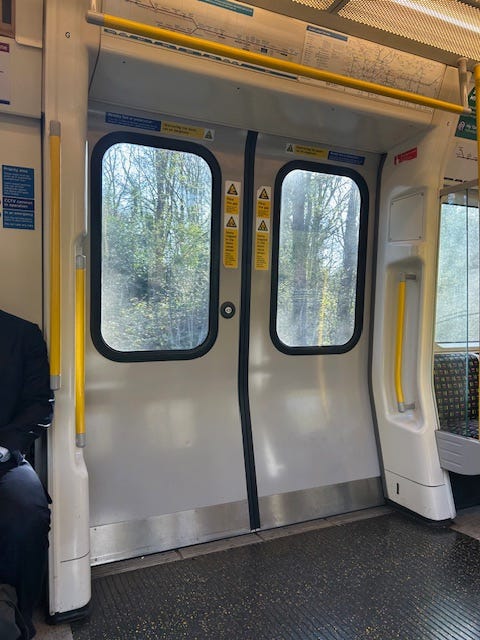
Travelling on the train into London recently, I was staring out of the window, letting the world move past, fast. Looking, but not focused on anything in particular. There were the usual trees, fields, houses, a car park and plenty of back gardens.
My phone was safely stowed in my bag.
That was a choice, though not a hard one. I’ve done plenty of digital detox, and this was not one of them.
As I looked around me, everybody was on their phone. We pick it up, it helps to pass time, to distract us. I get it. But when we allow ourselves to be consumed by something we guarantee that we don’t see anything else.
I see it as a parent too, the long car journeys when I see something cool out of the window and point it out to the kids. By the time they gaze up from their phones, it’s gone.
They don’t miss anything life-changing, but they do miss something simply different. They’ll never know unless they look. The phone was a guaranteed stream of something, the window offered the possibility of something unexpected.
Sometimes there will be something worth seeing but we only find it if we are open to looking. That possibility of something is worth protecting in my view.
We focus here, we notice this. It’s like the skill sits in directing our focus, finding the perfect thing worthy of our time, and focusing intently on it. But what if the real skill is actually the opposite of that? What if managing our attention were actually about reducing focus?
Maybe to be open to something you need to be closed to something else.
That is a decision, one many leaders don’t make, at least not explicitly and not honestly; what they are willing to call ‘a distraction’ that they should be closed to more often.
I am not referring to the obvious waste like phones. What I mean is the pointless meeting or the activity masquerading as legitimate work. A packed calendar, back to back calls, pursuit of inbox zero. These are often things keeping you from something else. They fill the space where possibility could be.
Dare to call it a distraction, even if it looks like work.
Your diary has this opportunity every day
The best executive assistants I had understood that their job was to keep people (more realistically, unnecessary meetings people asked for) out of my agenda. Protecting the space between things. My EA’s understood something that many leaders will take years to learn, that all empty space is not wasted time. It’s not inefficiency; it is the art of leadership.
There is space for thinking, there is space for possibility.
This week I had a handful of Zoom calls with people I didn’t know that well. I gave them my time from the “slush fund of unallocated time” not devoted to anything fixed this week.
Time box devotees amongst you may read this and wince - “How can anybody have unallocated time? How inefficient!”
New ideas emerged from these calls. If my diary had been wall to wall with meetings and appointments, they would have been missed.
I am not arguing that everything should be deep focused solitary work. Cal Newport and others have done this brilliantly already. Protecting time for deep work matters, but that is not what most leaders are missing.
Being in control of your time, and being available when it matters most are not the same thing.
The practice for managers to get on top of
People often lose track of their schedule in their time when they start managing people. But what if you saw 20% of your diary as being available for the stuff you’ve got no idea is coming? That to me is being a manager.
A colleague needs five minutes of your time, and that turns into a longer conversation. Someone stops you in the corridor with a question that deserves a real answer, not an off the cuff one. Someone shares something insightful while making tea in the kitchen.
I think the more seniority you hold, the more responsibility and more demands in your time, the more you need to show you are indeed available. Not just physically either.
A leader who is everywhere and technically available, but not actually available in the way that people will need them because they’re mentally focused on something else.
The one who’s got their eyes on the dashboard and every KPI the minute they enter into the meeting. They already know what they’re looking for and they don’t start to listen.
That’s the sort of leader who fills the silence with their own voice, never hearing what the silence, the body language, and the shifting on seats might have to have to say.
People who focus intently on something can feel oriented, but this often comes at the cost of the open mind, the cost of not being ready for the unexpected.
Your diary is your leadership philosophy, visible to others
Your diary shows without ambiguity what you believe matters. Do you have space that isn’t dedicated to something, space to allow you to breathe or to think, to be available?
I have a date with myself every Friday for what I call Blue Sky Thinking. Simply space that’s open; available in case there’s something that matters..
I use it to remove things from my calendar or carry forward things that might be important. I use it to subtract to create availability, and freeing my mind in the process too.
Your diary is the first signal your thinking is under threat, one meeting at a time as the space for possibility gets filled with things that may simply be a CYA for others who want your presence, not your contribution.
Whatever your people might need from you today, they may not have told you and you won’t see any of it if you’re already looking fixedly, at something else.
The question is whether you’ve got any time left after you’ve pencilled in everything else you choose to focus on.
Have a great week.
Fiona
Look again. See what was always there